
22 December 2023


06 August 2021

25 July 2018
Taking a Break
To the dear CMY community,
After long and heartfelt deliberation, I have decided to take some time away from teaching public yoga classes.
 |
| lighted path, wishes come true :: sfe 2018 |
Sharing this decision feels like practicing revolved triangle pose: It’s hard, I sort of dread it and feel like I’m about to fall over. But thanks to time and repetition, I know that if I do practice this challenge, some new space will be created and, after the hard part, I’ll revive the flow of energy in my body, the creative flow in my heart and the clarity in my mind.
For two decades yoga has been a source of healing and strength in my life. That remains. CMY has been a place of nourishment as a student and a cornerstone of my personal and professional development as a teacher. The intrinsic motivation to share the practice has felt divinely and inextricably guided by source. It has been an honor and a privilege to share yoga. I feel continually inspired to see, feel and hear the way that this practice has changed the lives of each of you who have shared it with me over many years. Thank you for this, for letting me into your space and trusting me to be a part of your experience. It is so hard to say that I will not see you in class on a weekly basis. This feels like practicing the pose I don’t want to practice but know I must because I’ve identified, as I say in class, a flat tire that needs some air. And as divinely guided as my public teaching has felt, so too is the call to turn inward, to be quieter and to reestablish a boundary between my practice and the business of yoga. Thanks to my intimate relationship with the practice I feel clear that the call to reclaim this boundary is important, necessary and timely. This feels both empowering and vulnerable…similar to how practicing yoga feels each time we practice with a sincere approach.
I’d love to close this letter by sharing my plan for the future but the truth is, I do not know what’s next. I know what I have come to learn and trust through years of practice: that awareness will light the way and trust in the deep call I hear in the quiet must be honored. And simply that it’s time to take a break.
So for now, and always, keep practicing. As I say upon closing each practice: feel gratitude for your body, your practice, your breath. Thank you for sharing your practice. I wish you a peaceful day, a peaceful week and wishes come true.
With love and gratitude, Stephanie
02 April 2018
Equinox
by Stephanie Frances Earls
 |
| VFS/sfe c 1975 |
holding hands again
our spirits straddle the distance
in the balance:
light and dark
life and death
this timeour spirits straddle the distance
in the balance:
light and dark
life and death
as you go
some things are not so
even...
breath…
breath…
quick
s
l
o
w
quick again
...is heart shaped
at the bottom of your throat
it’s not clear where the balance settles
as you push/slip through the passage
although in part the symmetry is sublime:
one twin comforting you here
the other reaching for you there
(i write so i don’t cry...
.
.
. until the day is quiet)
~ ~ ~ ~ ~ ~ ~ ~ ~ ~ ~ ~ ~ ~ ~ ~ ~ ~ ~ ~ ~ ~ ~ ~ ~ ~ ~
~ ~ ~ ~ ~ ~ ~ ~ ~ ~ ~ ~ ~ ~ ~ ~ ~ ~ ~ ~ ~ ~ ~ ~ ~ ~ ~
four equinox ago
you celebrated and saw me back
after i sailed through a passage
i’m taking it on faith
(and your word)
that you will be back
after you sail through yours
death is wonder
where/to? when?
transition is mystery
how do you feel? how do you feel?
is the light as bright
and the love as deep
and gentle
as it feels all around you now?
~ ~ ~ ~ ~ ~ ~ ~ ~ ~ ~ ~ ~ ~ ~ ~ ~ ~ ~ ~ ~ ~ ~ ~ ~ ~ ~
~ ~ ~ ~ ~ ~ ~ ~ ~ ~ ~ ~ ~ ~ ~ ~ ~ ~ ~ ~ ~ ~ ~ ~ ~ ~ ~
~ ~ ~ ~ ~ ~ ~ ~ ~ ~ ~ ~ ~ ~ ~ ~ ~ ~ ~ ~ ~ ~ ~ ~ ~ ~ ~
i take as comfort and confirmation
the otherworldly messages you delivered
with luminescent eyes when the fog cleared
the last time day and night were equal.
i take as comfort and confirmation
the movement of your mouth today when I said
I love you
(i’ll believe that you heard me from halfway there
and tried to say, so i could hear, here, I love you too)
i take as comfort and confirmation
your life
so well-lived with balance and goodness
that the heart shaped pulse of breath
at the base of your throat
became your parting expression.
for Bumpy ♡
 |
| vfs/sfe 2014 |
26 November 2017
Knit Tightly, Hold Lightly
by Stephanie F. Earls
 |
| SFE 2017 |
There is an invisible web woven in groups, in yoga, in life. From time to time the classes I’ve taught have lost members to life change/flow or injury/healing or birth/death. Likewise, I’ve been a student in groups that have resolved or classes with teachers who’ve retired or moved. I've also had to make my own changes as life has redirected me. Whether by our own choice or by causes beyond us, long or short term, these changes force a shift that reshapes our many webs; taking us out of some and into others. In yoga we are guided to hold dear the things that matter while not suffocating ourselves or others with our hold. Yoga philosophy names this notion of non-attachment aparigraha. It can manifest physically, such as when we prep for headstand and weave our fingers tightly at the webbing while we hold our fingers lightly over our hands. In both the physical and the philosophical, as the yogis say: knit tightly, hold lightly.
Recently, after receiving word of the passing of one of our beloved studio regulars, my Tuesday night class circled around. In our own ways we honored her with our voices and blessed her in our hearts and minds. It was a spontaneous and subtle emanation which I hope she could hear and feel from where she is. She held a part of the web at our studio. As the weeks pass we still feel her light and glow and we miss her in the place she held. Processing her loss brought to the forefront for me, how each of you, each of us, present and past/passed hold a dear place in our web. The echo you create calls forth gratitude in your void and in your presence. You matter.
It’s for each of us to say whether the concept of non-attachment is physically/psychically/emotionally easy or challenging in practice. The opportunity to practice is abundant as things change. Beyond the aforementioned student, life lately has shifted for so many people in my classes and communities: several loved ones lost, dear ones moved away, hearts and minds changed, schedules anew. The fall has been full of births and deaths in literal and figurative ways. We practice: knit tightly, hold lightly.
We welcome new arrivals to our classes/lives/hearts and concurrently for those who have left, feel it when you’re gone. Our groups feel the shifts because the corners of our webs that each individual holds include the intention, sometimes unspoken, that we choose to practice together. Regardless of how much or little we “actually know” about each other through talk or information, we feel and know each other deeply because we show up with a gentle willingness to move our bodies, be aware of our breath and practice feeling alive. If you are not here now the resonance of your spirit keeps your spot(s) humming. At the studio, each class knits tightly a weave all its own, a uniquely beautiful collection of people, insight and healing. We are here for each other, each of us teachers and each of us students.
11 July 2017
Let it Be: a Bit on Yin Yoga
by Stephanie F. Earls
Yin yoga is a phrase that describes an approach to Hatha yoga postures that is slower, less muscular and more meditative. It is a chance to practice being still within the parameters of 3-5 minute stays in postures to promote joint health. The physical movements help create space in the body so that being still becomes easier. The mental/emotional component promotes ease in the heart and mind. In time.
I could write a book (and many have) about all there is to yin. Today’s blog is about the
approach or mindset of yin yoga which is, in a word, receptivity. Nicknamed “the quiet practice”, I think of yin yoga as a chance to, as The Beatles sang, “let it be”. In setting an intention of receptivity, we cultivate a sense of openness to ourselves and our experience as we sit still and listen. Sometimes easier said than done.
Central Mass Yoga sits conveniently on a busy road. Sometimes the quiet space of the studio is accented by roaring 18 wheelers and revving Harleys outside studio A in the front of the building, and a garbage truck that comes to empty the dumpster outside studio C in the back of the building.
At 9:30 on Monday mornings, yin yoga happens in studio C. Once class begins, quiet descends and is decorated in summer months by chirping birds, a humming fan or distant rooster. We center our minds and settle our bodies, becoming still to take a look at what’s inside ourselves and whether it’s one of those days when we find peace of mind or a mind in pieces, a whole heart or a hole in the heart. It all seems pretty serene. And then the garbage truck shows up.
 Typically the truck rumbles in before 10:00 am but these last couple of weeks have been exceptionally quiet through the first half of class, windows open and a sweet breeze. I anticipate the truck’s arrival, knowing I’ll have to raise my voice and hoping it’s not enough distraction to discourage yogis from returning to class the next week. When the truck was late in recent weeks I hoped it was final reprieve. Its absence kept things simple for me, maybe simpler for the yogis too. But by the quietest closing moments of class, the truck banged in, crashed around while it unloaded the dumpster and took the trash away.
Yin yoga is one way to unplug and quiet the constant whirr, just like reading a book or having a cup of tea or taking a nap. Like any moment of quiet, as we become still we also become astutely aware of the slightest rumble: an ache in the body, a worried thought, a harsh self judgement…or on the other side, an elated emotion or pleasurable sensation. The garbage truck’s weekly showing is the perfect metaphor for the experience of quieting down to listen to ourselves. Inevitably, our peace is jostled by something disruptive and unexpected. Or, in anticipation of the unexpected, maybe to the point of needless worry, it never comes and we’ve spent those quiet moments bracing for the bang.
On the outside at the studio it’s rumbling garbage trucks, clanging dumpsters or revving motorcycles. Internally it might be garbage thoughts, clanging emotions or stale memories. Whether we consider them positive or negative, pleasurable or painful, the experiences that come up when we get quiet are part of the process while we steady our roots in the foundation of our inner truth. Ripples of doubt and delight, gratitude and grievance, whether they be physical, emotional or mental are not markers of success or failure when we practice peace of mind and self care. They are just ebbs and flows in the tides of our experience. We drop the anchor when we remember that sitting with ourselves need not be about denying any of the garbage (or grandeur) that surfaces and likewise not riding away with the garbage truck. We drop our anchor when we see the garbage truck come, do its thing and go, knowing it will be temporary.
In yin yoga the practice moves slow. We linger in the poses to create space in the body, while we give ourselves time in mind and heart to practice and reaffirm that what comes up is simply part of being a person. We listen to ourselves the way we would listen to a good friend who needs our attention: with an open ear, soft eyes and tender heart. We know each pose (and the thoughts and feelings with it) will last a few minutes but like the truck, will come and go.
With slow, receptive practice we have the chance to break free of the dumpster collections in the corners of our mind, heart and body. Some of that garbage clears out quickly. Some we practice with for decades. We try to remember that everything in the dumpster was at one point nourishing (yummy or useful or helpful). The thoughts, feelings and sensations circulating have served us and will continue to until it’s time for them to go. Allowing things to be as they are, we strengthen our ability to open a path so that what needs to come in can come in, and what needs to go out can go out without our gripping or pushing or forcing.
We can use the practice to handle anything that clutters the scene while we root to our inner truth. With awareness we can choose to shift focus to where we want it to be. When our inner voice sounds muffled under rubble, when we are not sure where we want our focus to be, the practice is here without pretense, without expectation, providing a structure to anchor ourselves in. And when we hear our inner truth again, we can steady ourselves regardless of the grievances or gratitudes at hand. We can settle roots in our truth so that no matter how many garbage thoughts or garbage trucks come roaring by, no matter how many motorcycles of the mind startle us, we know our way back to that healthy space where we are still and able to hear ourselves. In that fold rests our freedom, not a finish line to cross, but a path to walk or rumble along.
18 March 2017
Discovery
for all our loves, lost too soon
by Stephanie F. Earls
you(2)
by Stephanie F. Earls
you(2)
shone in the quiet,
dark days
a solstice storm
on the way in
and on the way out
union and void
invisible evidence
in your wake
binary stars
(y)our vesicas
a paradox of infinity
too far to touch
yet warm in heart
death and life hold hands
longing is (l)onl(e)y
quenched with hope
so you are written
while slipping or setting (i’m not sure which)
into distant sky
eyes and heart too spellbound
to write you sooner
in the midst of
fire and light
storm and sea
clarity and confusion
truth
once seen by naked eye
now a pulse of memory and potential
part of
every sun, every moon
i knew the last (first) time i saw you
would be the last time i saw you
i knew i would miss you
even before you knew you were gone
**
oh starlights, how to deliver
tender vulnerability?
how to keep it protected
as it births?
27 February 2017
You Carry Your Magic Inside
By Stephanie F. Earls
Browse the internet, social media or certain yoga publications and you might get the impression that a mastered practice requires specific physical ability or certain clothes, beads or candles. You might think you have not gotten “there” unless you study with a revered teacher, practice hours a day or can do a challenging pose. But something yogis, especially teachers, come up against is how to show yoga without giving the impression that the show is the thing. The truth of yoga can not be shown, it must be experienced. What we show (even this blog in words and picture) is a metaphor that attempts to hint at the truth that yoga points us to, the truth that is in us. Yoga and healing are not about the props or crystals or candles or clothes. Beautiful symbols, inspiring icons and our teachers can help us focus and enrich our surroundings or they can become crutches in the pursuit of self care and self realization. One of my intentions as a teacher is to equip students with the ability to free themselves by discerning between externals that support the journey inward and externals that distract or create dependence. I am in it (this work) to share ideas and ways to practice that have freed and empowered me. I teach to help others learn to teach (and free) themselves.
 |
| sfe 2015 |
Like an invisible turtle shell, yoga provides safe refuge from the pitfalls of life: self doubt, worry, anxiety, aggravation, illness, addiction, grief.…and like invisible wings, yoga lifts us to the joys of life: peace of mind, health in body, love in heart. The philosophy and physicality of the practice can be used anywhere whether or not the right teacher or accessory is there, whether or not you can form a pose, because rather than showing a way out, yoga shows a way in… where the magic is.
It was a blessing that I found yoga when I did, almost two decades ago suffering from Crohn’s disease. I was too sick to make it through a class so I did my yoga at home in bits and pieces, in pjs, morning or night; in gas station bathrooms or in doctors’ offices. I did what I could, where I could, to survive moment to moment. The moments of opportunity to practice were small and there was no time to get everything right. On occasion I had my mat, or some quiet or could light a candle or play soothing music. But usually, day to day, I needed a safety net QUICK; noise all around, no time for beautiful trimmings or teachers or cute yoga outfits. I was forced by illness to strip the practice down to the essential: simple stretches, conscious breath, accessible meditation.
If I had waited for the perfect ambiance I’d still be sick. I trained myself to heal and to access healing in the most raw and un-accessorized way possible, with pure intention and energy. I trained myself to practice anywhere, anytime, anyway because I wanted to feel better and had agreed with myself to pursue health even if everything was not in its place, even if it didn’t look good. I was sick, it didn’t look good! Had smart phones or social media been around, snapshots of my practice would have been a real downer from the outside. But from the inside it was real and uplifting! AND it was liberating because the perfect situation was not required. The practice as I knew it was (and is) portable. At the end of the day it was just me and my body, my pain, my comfort and eventually my healing. I had found the internal tools and a foolproof, self sustaining way to access those tools and healing anytime so I could feel better, so I could live. The ability to tap into myself anytime/ anyway/ anywhere with or without stuff is one of the best gifts I’ve learned from practicing.
I share the tools I’ve learned and cultivated so that those who study with me will learn to create an entry into their own personal wellspring of internal source. For me it came through a health struggle, but that does not need to be the case. A simple sense of curiosity and desire to give self care is enough to enrich your path inward. Like any path we come to with an open heart, we get to decide if we fall into its trappings or float with its wings.
So while ideally we establish a routine in practice and cultivate steadiness we hold close the understanding that the heart of the practice is with us no matter where we are and even if the routine is upended. We cultivate the care to maintain that practice even if the accessories drop away or we come up against a physical limitation. If you think you NEED a mat or a cushion or a candle to do yoga I am here to encourage you to liberate yourself. If you feel your practice won't be just right without your favorite spot in the room or with your preferred teacher or at the right time of day, I encourage you to do it anyway and liberate your practice. If it creates beauty and love to wear your favorite mala beads so be it, but on the day you forget them at home, rest in the knowingness that you can harness your meditation and your healing even without them. The love and the routine that is symbolized by your accessories floats with you like magic. It is your eternal and internal light and authenticity. Empower yourself to lighten up. Return, repeat, refine and if you want to really master your practice remember it’s not about being able to stand on one hand or put your leg behind your head. It is not about looking perfect in the right yoga pants. Instead, welcome the chances to shed the extra. Rather than waiting for that class at the end of the day, fold forward in your chair, belly on thighs, let your head hang and feel stress flow off your body. Stand up and reach for the sky when you feel confined. Stand your ground when you’re up and rest easy when you’re down. It’s not rocket science. It’s common sense magic. It is available to you anytime, anywhere. All that matters is the fact that you can pull your practice from inside. All that matters is that little by little you practice stepping into your independence. Draw upon what you have learned or read or practiced with teachers and prioritize the voice within. Listen to your body and give it care. This is your healing path. This is your personal journey. You carry your magic inside you.
If you are reading this blog upon its release, there is still time to register for 8 Limbs in 8 Weeks, my 8 week course of yoga study beginning March 6th. We will explore the bones of yoga and cultivate a more nuanced sense of self exploration. Find out more and register under the workshops tab at
Central Mass Yoga or email me at SE.BreatheHere@gmail.com.
20 October 2016
Tough Thoughts? Three Techniques to Tidy the Mind
by Stephanie F. Earls
Hello friends and yogis! Last time I wrote for you I shared five simple postures (asanas) to freshen up the body. Some days a handful of stretches is all it takes to freshen up the mind too. Other days the mind over-does, obsessing about the past or anticipating the future. Whether it’s anticipatory anxieties, deafening doubts, woeful worries or all-encompassing emotions, the result is often elusive peace of mind.
 |
| sfe 2015 |
Asana (physical posture) is the third of 8 limbs of yoga. We use each of the 8 limbs in conjunction with the others to cultivate integrated body-mind-spirit. Physical movements prepare the body for meditation or Dhyana, the 7th limb. So, what happens if the body feels ready to sit still but the mind is restless? This is where exercising concentration, Dharana, the 6th limb, comes in handy. There are many techniques. Here are three simple and effective approaches to focusing the mind, quieting intrusive thoughts. Intrusive thoughts are any thoughts that feel overwhelming or distracting.
1. Breath Awareness
Sometimes easier said than done breath awareness is almost too easy. Step 1. Become aware of your breath. Step 2. Repeat step 1.
What is it to be aware of your breath? Awareness in this case is an open canvas. Watch, listen, feel, sense the breath move in and out of the body. It does not matter if the breath is quick or slow, deep or shallow, loud or soft. Simply notice how it feels. Can you notice the sensation of air at the tip of the nose? Is there sound to the breath? Where does the body move and where is it still as the breath comes and goes? Which parts of you get bigger with inhalation? Which parts get smaller with exhalation? You do not have to change anything. Follow the inhale all the way in and the exhale all the way out. Be curious. The breath is your life force and being present to watch it as it is, is the doorway to unconditional acceptance of yourself as you are. Practicing self acceptance will quiet the mind.
We begin each yoga practice with breath awareness because attention on the breath links awareness to the present moment. Breath awareness works because we can not breathe yesterday and we can not breathe tomorrow. We only breathe here, now. Watching the breath is watching the present moment. The mind on the present will shed its worries of what was, anticipations of what will be and turn to what is now.
This practice is enough. However if the mind is stubborn, reinforce awareness of the breath using mantra to build concentration…
2. Mindful Breathing
Breath centered mantra is a variation on breath awareness. Mantra is loosely defined as a repeated word or phrase. Almost anything can be a mantra. In yoga, sanskrit words or sounds are often used this way. This particular mantra uses English words and comes from the writings of delightful Buddhist monk Thich Nhat Hanh. It simply and powerfully reinforces the link between the mind (awareness) and breath (life force/body) with phrases repeated silently.
It is easy. While you breathe, say to yourself:
Breathing in: “I know I am breathing in.”
Breathing out: “I know I am breathing out.”
As the breath slows and the mind quiets you can adjust the mantra, shortening it to “breathing in, breathing out” or eventually pared-down to “in,” “out”.
That’s all there is to it. Sounds easy right? What is fun and funny about this practice is that the mind is spry and can be tricky. You might find yourself saying the mantra but breathing out of sync with the phrase. See if you can stay present to bring the two together.
In time this practice will feel natural. Make it your own. Vary the phrase to steer your mind and capture what you want to cultivate as you breathe in and out.
My favorite variation and one I teach often is
Breathing in: “I arrive in my body.”
Breathing out: “I am home.”
Feel these words. They are magic. They focus the mind on the breath and affirm a settling into the body. Pure, powerful.
Breathing in: “I arrive in my body.”
Breathing out: “I am home.”
As Thich Nhat Hanh says, Your body is your first home. This life affirming mantra creates comfort for body, mind and spirit.
Breath centered mantra can be done for 3 or 30 or 300 minutes on your mat, or while brushing your teeth, or in your car when you get stressed about the slow poke in front of you. Practice when your body winces about a long hold in a pose or cramps up while you run. Practice while healing an ailment - long or short term - including obsessive thoughts. Practice in seated meditation. This technique is easy, nourishing, and an opportunity to replace intrusive thoughts with presence and affirmation.
3. The Sitali Breath
The Sitali breath is one of many breath exercises (Pranayama, the 4th limb) in yoga. Pranayama moves energy in the body, focuses the mind and integrates the body-mind connection. Each pranayama has a different effect. Sitali is a cooling breath, useful for simmering hot thoughts as well as hot flashes. It quiets the mind because it organizes attention around a pattern of breathing that passes the inhale over the shaped, still tongue. There are theories that the movement of the mind is linked to movement of the tongue (there is certainly a connection there with talking) and perhaps by stilling the tongue there is a correlation and stilling of the mind.
There are several benefits of this breathing exercise. For today’s purpose we are considering the effects of Sitali in cooling hot, frenetic thoughts (anger, anxiety, over-excitement, etc).
To begin, curl the edges of the tongue up, forming a roll and reach the tongue just slightly forward of the teeth (between the lips). If the tongue does not roll, tuck the tip of the tongue behind the top teeth, exposing the back of the tongue, or touch the front teeth together, leave the lips gently open (technically Sitkari breath). Once you’ve set your mouth in place draw the breath in through the mouth. The air will feel cool through the rolled tongue (as if drinking through a straw) or as it hits the back of the tongue or passes through the teeth. Regardless of the variation, the tongue will be still. Upon full on inhalation, close the mouth and breathe out through the nose. Try a minute or two and pause to feel the effects, letting the natural breath return in and out through the nose. If the mind remains wired, re-engage Sitali breath.
The practice of Sitali quiets anxieties and emotions that create a heated mind. It will cool the physical body so can be a great help during hot spells of weather or hot flashes due to hormonal shifts or illness. Heading into fall this practice might not feel appropriate if the weather is raw but if you find yourself struggling with heated thoughts (or body) give it a try.
Create your Calm
 |
| sfe2016 |
Remember, thinking is not a problem in and of itself. Intrusive thoughts that overwhelm or distract us and compromise our peace of mind are what we work to settle. Use these techniques in conjunction with physical practice (asana), seated meditation or let’s be real, anytime/anywhere you notice your thoughts running away with your peace of mind and heightening your nerves. Most of our life is practice off the mat and these portable techniques are tools to organize at any moment when thoughts become intrusive. They create order out chaos. Give these simple techniques a try. Continue painting your practice, create your calm. Remember that you are your own best teacher and employ these techniques or leave them by the wayside as you figure out what helps you tidy the mind.
07 July 2016
Five Minutes? Five Foundational Poses to Freshen Up
by Stephanie F. Earls

Child’s Pose Variation
Years ago as a new teacher I heard an interview with composer Stephen Sondheim. When asked about art he said, “Art in itself, is an attempt to bring order out of chaos.”
This captured something I feel about yoga. Yoga is art to me: a combination of boundaries and freedom that facilitates creativity. It is a framework that we can use to cultivate safe haven when life (interiorly and exteriorly) feels chaotic or uncertain. Yoga doesn’t hold false promises. It simply leaves itself for us, as if on our doorstep like a package, available to be unwrapped and explored, with curiosity. The deeper I delve into the practice the more I realize that the most simple things can be the most enlightening; the more I trust that yoga is reprieve. Yoga has taught me that our spirit is the source of our safety and our essence is ease.
In a past post Healing is Real I explained how my own healing and comfort were cultivated day to day with sometimes the smallest efforts. In that light and with a more practical edge, here I share five staples of my home practice to spark your own or to serve as a blueprint to help you feel stronger and more spacious in your body if even just for five minutes. No mat required! All you need is your body and your presence of mind. Take it slow and hold each pose or link them together for a simple, effective flow. Come to class to learn nuance and polish your form. At home keep it simple, listen to your intuition and do what feels good. Notice your breath.
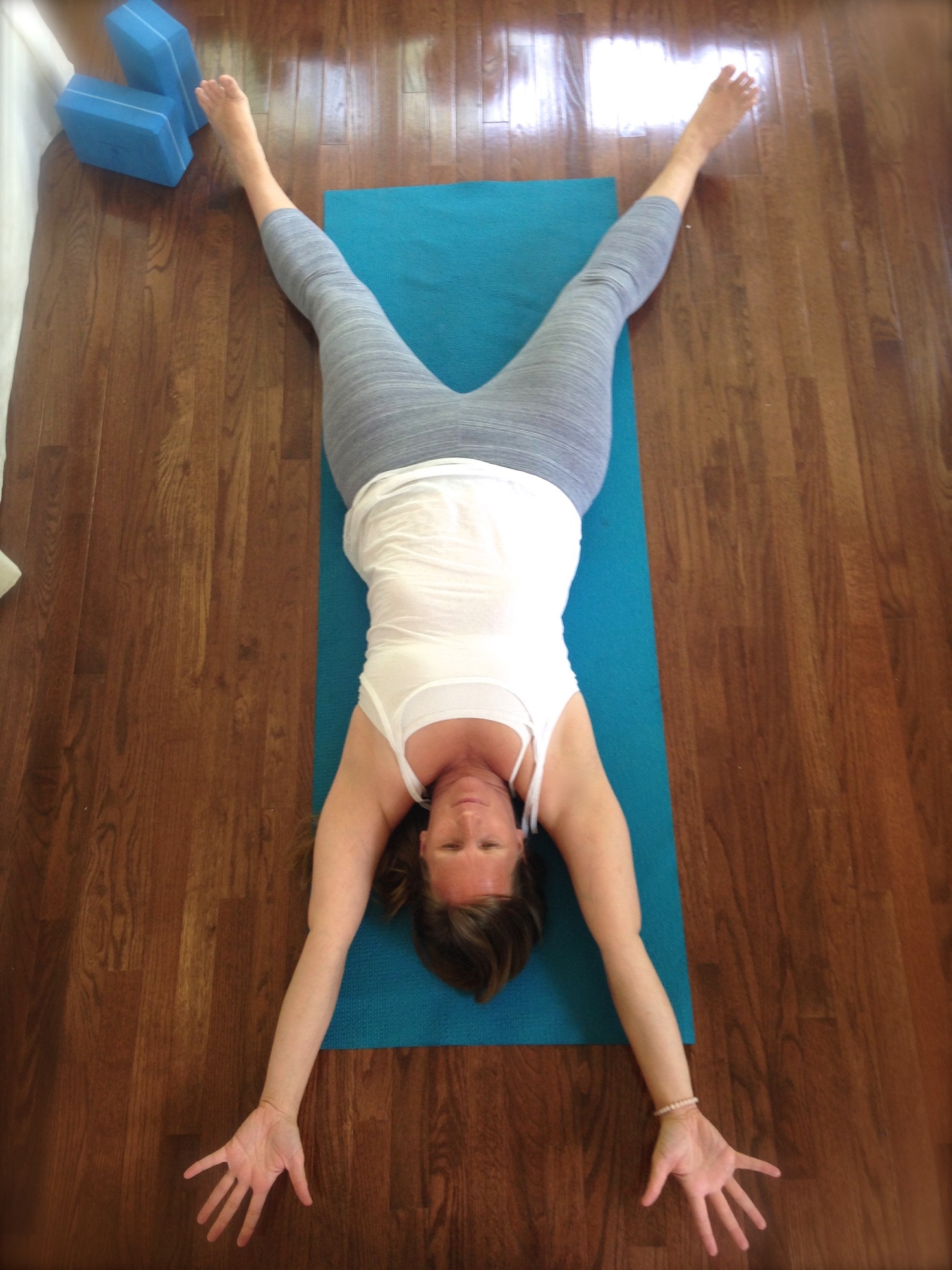
Symmetrical Stretch
1. Symmetrical Stretch can be done standing up or laying down. Are you just waking up? Try it in your bed. Have you been stuck at a desk? Stand up and reach for the sky. This pose is so easy and intuitive you don’t need a yoga teacher to “get it”. Reach your arms up over head and stretch your legs forward. If you are standing up, push your feet down and energetically apart against the ground or rise to tip toes. If you are laying, point your toes and then flex your feet. Which way makes you feel better? Vary the stretch in the arms by hooking the thumbs and try to reach your arms apart, or interlace the fingers and flip the palms…or my favorite, open your body like letter X. Try swaying a little to the right and left. Think of this as a wake up stretch. What does your breath do?

Child’s Pose
2. Child’s pose/Balasana and Knees to Chest are two poses but one in the same depending on how you look at it. One might be easier than the other if you have tender knees or hips. If you are on your back bring knees to chest, hold the knees with your hands or reach for your feet. Knees can be together or apart, close to the body or over the hips. Place your legs so that your back feels comfortable or stretch the back by lifting your upper body off the floor. For a gentler version support your head with a blanket and rock your head side to side to release your neck. Knees to chest eases a tired back. If your hips and knees are healthy take the same shape facing the ground in Child’s pose/Balasana. Start on hands and knees and sit back as if you are putting your hips on your heels. Let the back round. Knees can be together (to support the low back) or apart (to give more room for the body and breath). Rest your head on the floor or your hands. Practicing child’s pose quiets the mind and calms the nervous system. The energy of this pose is a bit like a shell for a turtle, protective and quiet.
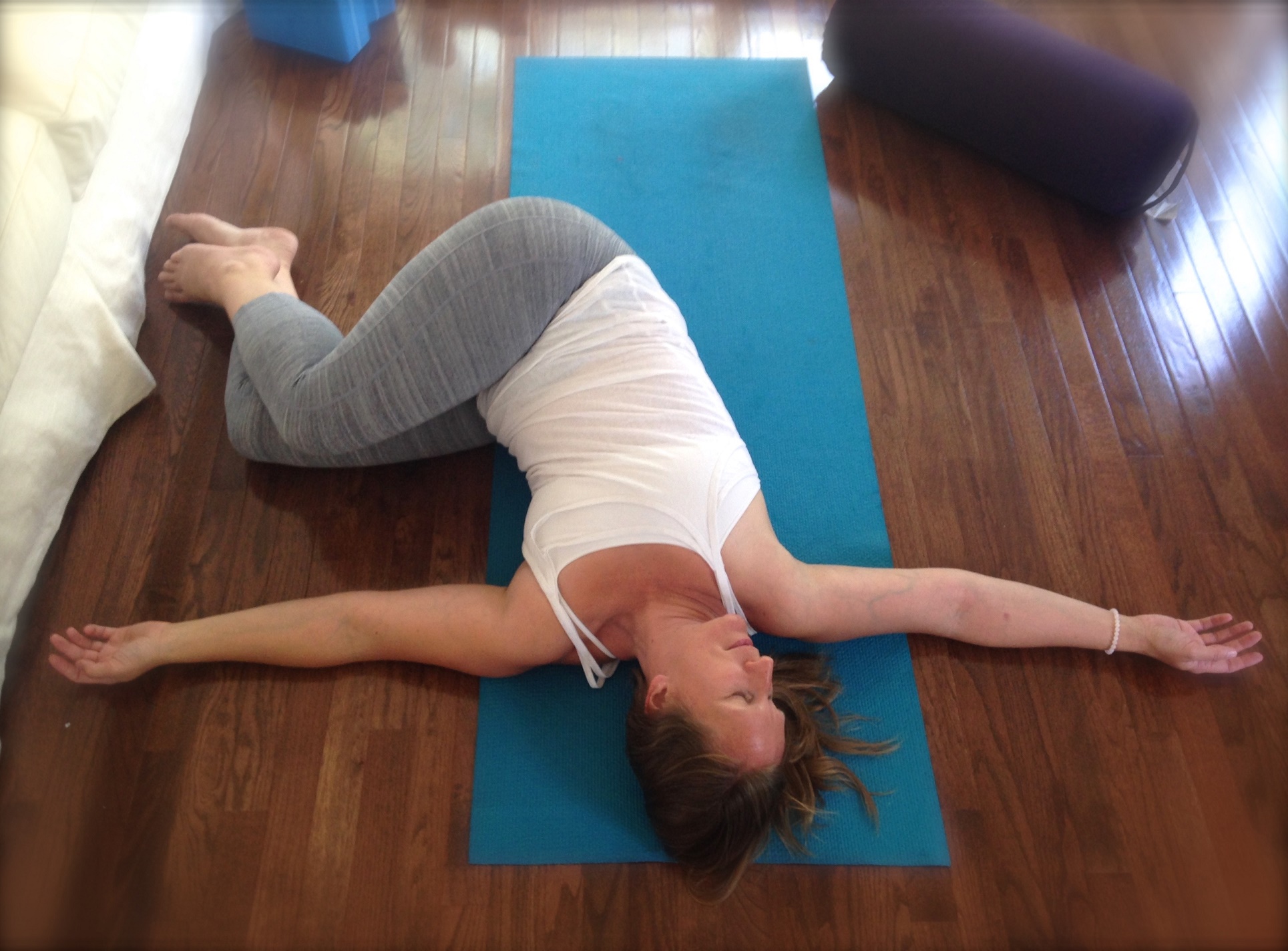
Reclined Twist
3. Reclined Easy Twist. Twists feel great and this one is easy. Lay on your back and bring your knees toward your chest and then drop both knees to one side. Open your arms out to the sides like letter T or put one hand on your belly or ribs to get tactile feedback about the rhythm of your breath. Turn your head in the direction that feels easy. Stretch through it or just rest and wait and let the twist do the work for you. Switch sides. This pose makes room for deeper breaths because it opens up lung space in the chest, ribs, collarbones and back. It also encourages healthy digestion.

Downward Facing Dog
4. Downward Facing Dog/Adho Mukha Shvanasana is a stretch and strengthener for the whole body. It looks like an upside-down V. Start from hands and knees: tuck your toes and push into your hands so that your hips come up into the air. Imagine stretching your spine as your hips lift up and your arms energetically push forward. Keep the knees bent if you need and reach through your heels. I remember one friend and teacher used to say “forget this is called down dog and just think of it as holding yourself up on your hands and feet with your butt in the air.” I loved that because it freed me up to figure out the most efficient way to hold myself in the pose and made it a little more fun. There are many ways to refine this posture and they are important and worthwhile. Refine if that feels good or let that be your motivation to come to class. Sometimes letting go of the picky details and moving freely in ways to feel comfortable (stable, spacious and strong) does the trick at home. Trust your intuition.

5. Low Lunge/Anjaneyasana is one of my favorite poses for its ability to strengthen, ground, tone and stretch the body. It encourages space in the hips, length in the torso and lift in the heart. It is invigorating. From Downward Dog or from hands and knees, step one foot between your hands so that the knee is over the ankle. Set the back knee down and slide it a bit behind the back hip to feel a slight stretch at the front of the hip. Press the top of your back foot into the ground and press down and energetically forward with your front foot so that the torso lifts up off the front thigh. Extend this pose into your arms by reaching toward the sky. Lift your gaze, lift your intention. Try little movements or a deep breath to cultivate ease while you work. Switch legs and repeat.
These poses get the job done whether you need to make space in your body, calm your nerves, or energize yourself. Practice these poses simply, combine elements or embellish them with your personal touch, even if for five minutes. When you do, see how moving your body and paying attention to yourself refocuses you. Use your body to freshen your mind and heart. Create your art. Bring order out of chaos.
If you have questions or want to practice with me I am available for private instruction
Monday 930am Yin Yoga
Tuesday 530pm Hatha 1
Wednesday 930am Hatha 2/3
Tuesday 530pm Hatha 1
Wednesday 930am Hatha 2/3
Subscribe to:
Posts (Atom)